

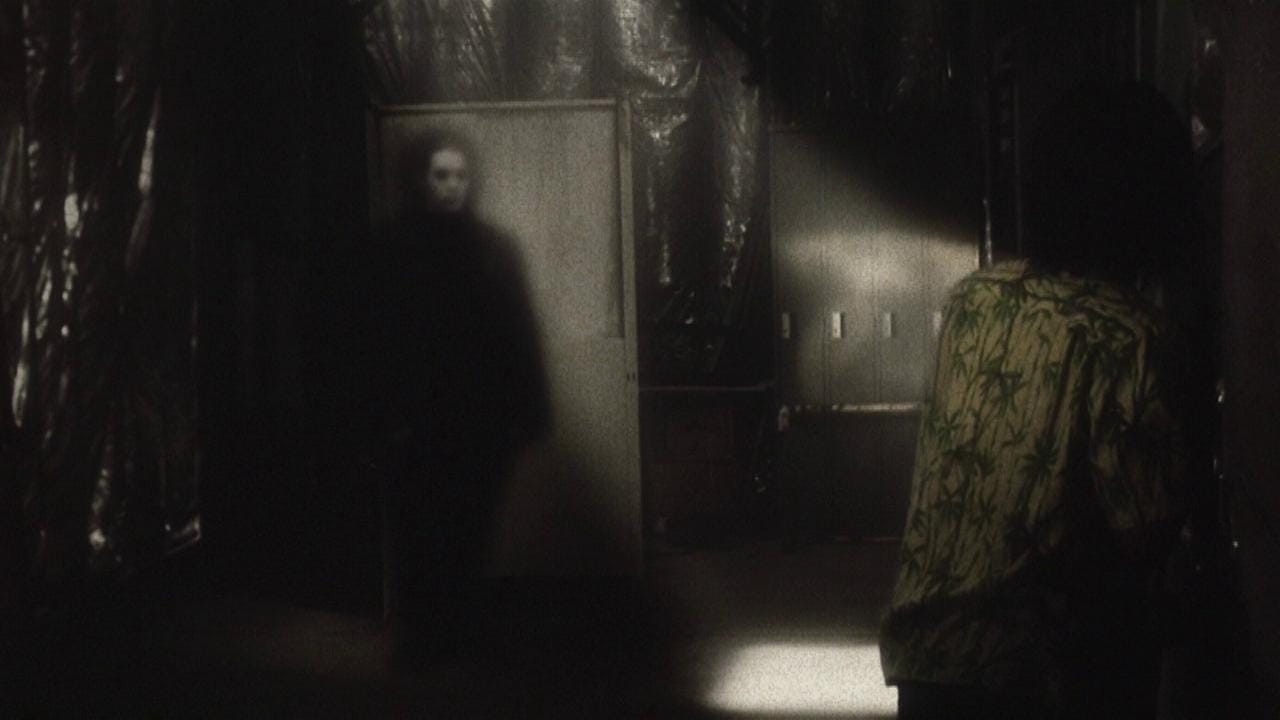
In Jūran Hisao’s 1948 short story “The Prophecy,” Tadayoshi Abe meets with two of his friends the day before his wedding to Chiyoko, the daughter of the wealthy Sakata family. Tadayoshi, who comes from an aristocratic family that became impoverished after the collapse of the Fifteenth Bank in 1944, cheerfully tells them about a strange letter he received from Toshimichi Ishiguro, a psychiatrist he’s acquainted with. In the densely written letter which contains “arcane references to karma and the transmigration of the soul,” Toshimichi tells Tadayoshi that he will die by suicide aboard the French liner André Lebon on his way to his honeymoon in France but not before shooting Chiyoko and another passenger dead. Tadayoshi laughs it off, dismissing it as the ramblings of a man in the throes of despair.
Toshimichi’s wife committed suicide following rumors of an affair between her and Tadayoshi. Even though Tadayoshi denied it, the episode caused a scandal and it was decided that he and Chiyoko should marry as quickly as possible before departing for their honeymoon the following day. While Toshimichi is described as having “a dark side, malicious, vindictive and spiteful,” Tadayoshi is unbothered and even says he invited Toshimichi to his wedding in hopes of smoothing things over. One of his friends, however, tells him about two mysterious suicides that, so he suggests, might have been the doing of the psychiatrist.
“That’s quite a story. Two inexplicable deaths. But are you saying Ishiguro was somehow involved?”
“Well, who can say? I do know he studied animal magnetism under Bernheim. Then there’s the example of Rasputin, that thorn in the side of the House of Romanov. He was a disciple of Mesmer. It’s said anyone who plotted against him, died by their own hand under mysterious circumstances. There were ten such cases in the imperial court alone.”
“The power to control another person’s mind. It’s a terrifying thought. But surely that kind of psychic ability is not really possible.”
“It’s possible alright. What’s worse, anyone who possesses such a power can use it at will. I’ve done my own research into the work of Jean-Martin Charcot, as well as Bernheim. I could go on, but there’d be no point, in the end people believe whatever they want to believe.”
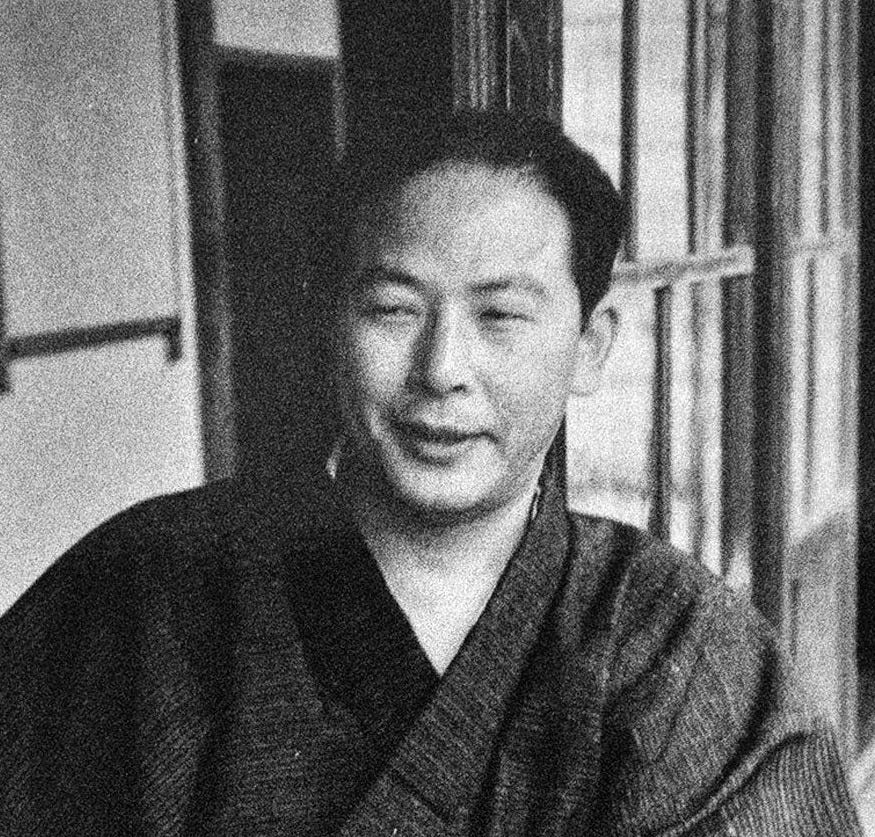
Of course, by the end of Hisao’s story the titular prophecy turns out to be true but it is Tadayoshi’s friend who actually prophesizes how the story will play out: Tadayoshi will indeed die by his own hand but it will be due to being hypnotized by Toshimichi. The bulk of the narrative takes place on the luxury liner that’s supposed to take the newlyweds to France. Things play out exactly as described in the letter until “[Tadayoshi’s] world shook once more and flipped upside-down,” revealing the wedding reception and subsequent voyage as an elaborate hallucination. A confused Tadayoshi finds himself back at the reception, staggering inside the dining hall, mopping sweat from his brow, and finally shooting himself in the chest with a gun he had received as a gift moments earlier.
“But why do such a foolish thing?” Sakata asked.
Abe’s eyes sparkled, “I was hypnotised by Ishiguro. In the corridor before I entered the hall. That’s when he must’ve done it. It’s funny. Before that harpist finished her tune, I made it all the way to Naples.”
Abe wasn’t aware there was no hope. He happily recounted all the details of his ocean journey, which seemed all the more unearthly since we knew he hadn’t long left to live.
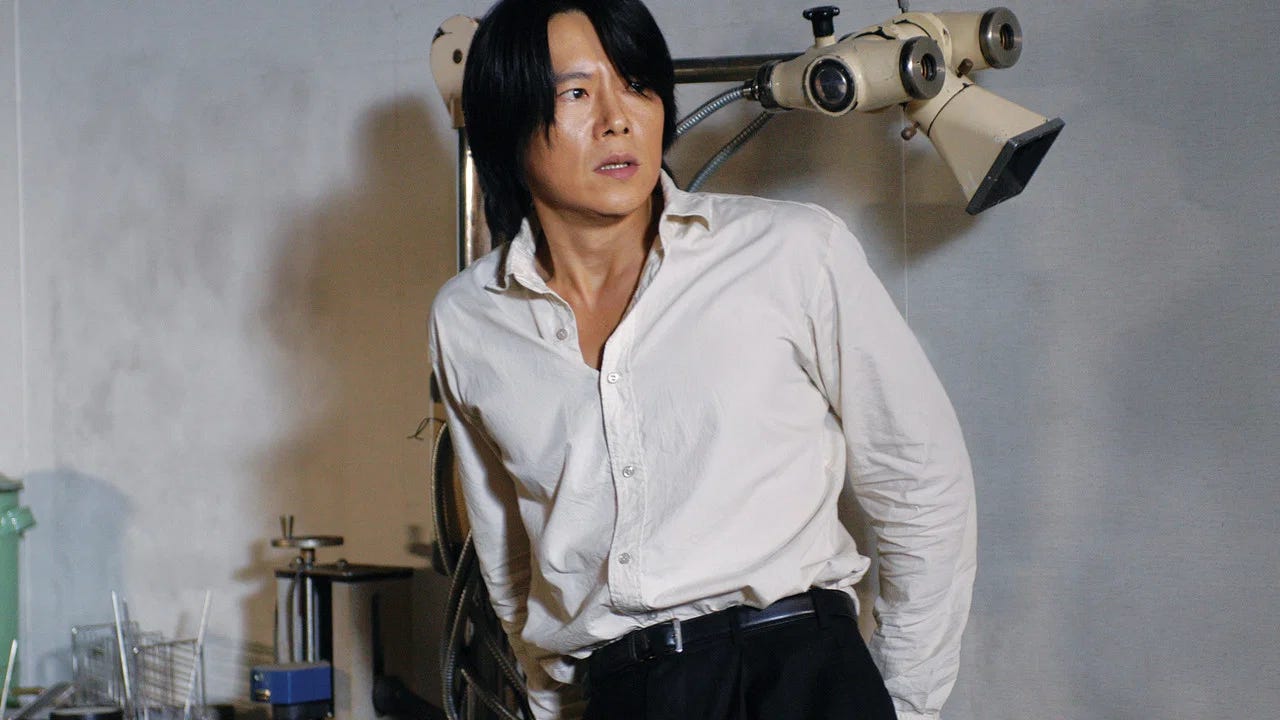
“The Prophecy” has curious preoccupation with hypnosis (or “mesmerism”) that it shares in common with Kiyoshi Kurosawa’s 1997 psychological thriller Cure. The film, like the short story, features an antagonist with an interest (an obsession, really) in psychology, hypnosis, and mind control and both go as far as mentioning the German physician Franz Mesmer, who first theorized what is now referred to as mesmerism, by name. But whereas Hisao’s care- and clueless main character finds himself confronted with a simple, horrible truth — a despondent widower blames him for the death of his wife and decides to exert a mesmeric influence to drive him to commit suicide — Kurosawa’s troubled Kenichi Takabe (played by frequent Kurosawa collaborator Kōji Yakusho), a detective with the Tokyo Metropolitan Police, is unsure what exactly he is even being confronted with.
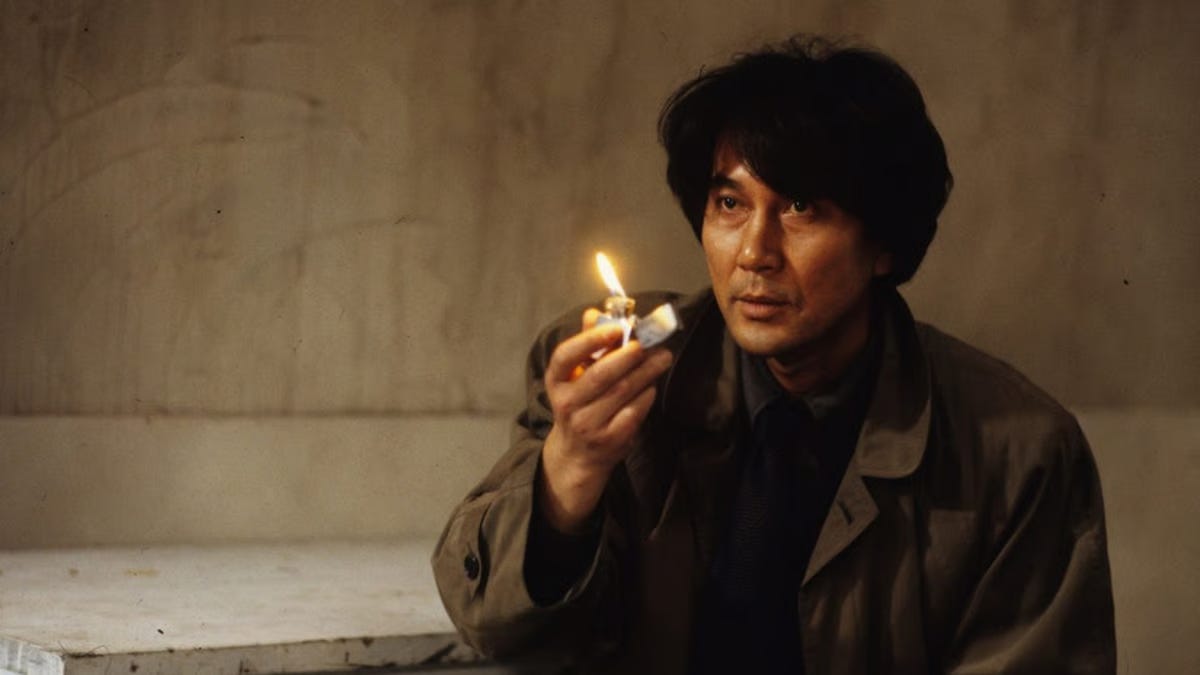
The string of bizarre and gruesome murders that brings Takabe into the orbit of the mysterious Mamiya (Masato Hagiwara) all seem to have been committed at random, with seemingly no provocation at all. The perpetrators are always found close to the scene of the crime and though they readily confess, they can’t seem to explain their actions after the fact. Takabe and forensic psyhcologist Shin Sakuma (Tsuyoshi Ujiki) speculate on possible motives, with the former mentioning films, novels, and childhood trauma but it isn’t until the two men realize that each of the murderers came into contact with Mamiya shortly before the killings that the shape of the film’s mystery comes into focus.
Takabe, whose wife Fumie (Anna Nakagawa) suffers from bouts of severe mental illness, implied to be schizophrenia, becomes consumed by the case and by the young drifter at the center of it, barely managing to contain his fury during the first interrogation. Mamiya appears to be suffering from severe short-term memory loss but after searching his apartment where he finds evidence that Mamiya used to study psychology before becoming fixated on hypnosis and mesmerism, Takabe concludes he must be faking his memory problems to get victims to lower their defenses, allowing him to plant homicidal thoughts in their minds. During another interrogation, Mamiya constantly dodges Takabe’s questions and instead probes the detective with invasive questions about his private life causing the detective to finally lose his temper, angrily confessing to feeling resentful toward his wife. Mamiya, meanwhile, reacts to the outburst with mild amusement.
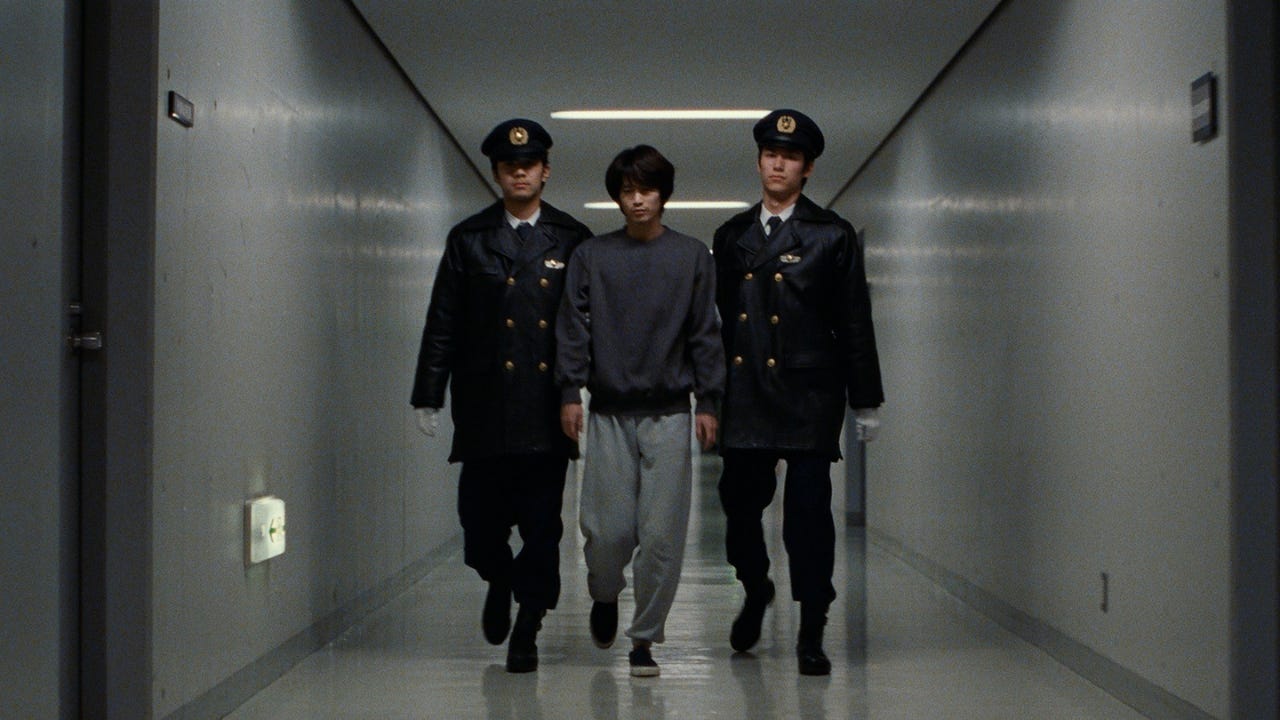
Though he fails to secure a confession, Takabe charges Mamiya with incitement to murder. Notably though, it is Takabe’s confession that significantly alters the trajectory of his arc and indeed the entire film. While he was momentarily beset by eerie flashes of images, something akin to visions, after searching Mamiya’s dark and littered apartment — aside from books and student records he also finds the decomposed remains of a monkey tied to the shower pipe and contorted into a strange, pseudo-religious position by wires which appears in his vision as well — these brief bursts develop into full-blown hallucinations, a notable one being of Fumie’s lifeless corpse hanging from the kitchen ceiling by a noose.
What Takabe sees is not as elaborate as Tadayoshi’s hallucination of an entire ocean journey but they ultimately serve a similar purpose in that they begin clawing away at the complacent, placated consciousness of their characters. The process of Tadayoshi’s eventual death isn’t put into motion by hypnosis but rather by an alleged indiscretion that puts cracks in the facade of propriety of the aristocratic circles he moves in. Similarly, Takabe’s seemingly well-ordered life first loses its equilibrium with Fumie’s declining mental health, though the fully destabilizing presence of Mamiya doesn’t lead to suicide but instead prompts Takabe to murder his wife and fatally shoot Mamiya before taking up his mantle.
What makes Cure so potent (and moves it beyond the pulp simplicity of Hisao’s short story) is the Hooperian sense that there are forces lurking just outside the margins of the frame, a political–historical gaping maw that seems poised to eventually consume the entire world. What complicates the reductive and surprisingly common conception of evil as an invading force in Cure is, of course, the ambiguity with which it not only spreads but comes to be in the first place. The evil in Kurosawa’s film is not an aberration but rather the manifestation of accumulated sins — sins that he sought to exorcise at the turn of the millennium. “I think the vague idea I had at the time,” said the filmmaker in a 2005 interview with Reverse Shot, “was that we were really on the cusp of a new century. The idea was to abandon, by destroying everything from the 20th century in order to head into a good, new future. It wasn’t that the apocalyptic vision was negative or despairing, it was positive, a way to get rid of old baggage.”
The question subsequently becomes what exactly this “old baggage” is. Cure points toward a variety of social contexts (heterosexual relationships, families, workplaces) as sites where evil festers and grows but his social criticism also comes with historical specificity: the 1990s were a period of stagnation for Japan after the asset price bubble burst in early 1992, putting an end to the neoliberal optimism that came along with Japan’s emergence as a major economic player on the world stage the decade prior. Intensifying the crisis were sarin attacks in Matsumoto and the Tokyo subway in 1994 and ‘95, respectively, carried out by the Aum Shinrikyo doomsday cult. The attacks killed 22 and injured upwards of 1,500 people and the subway attack remains the deadliest act of terrorism in the history of Japan.
Of course, Kurosawa wasn’t the only filmmaker for whom the era’s malaise was reflected in their work — directors such as Takahisa Zeze, Gakuryu Ishii, Hisayasu Satō, Shinya Tsukamoto, and Takashi Ishii all created portraits of extreme violence, pervasive paranoia, and spiritual and moral decay — but there is an acute sense of history to his work that goes beyond that of his contemporaries. There is real rigor to his engagement with the world as it is, something he has carried over into the 21st century, but the roots of the forces that motor his films reach beyond the ‘90s, beyond World War II, sometimes reaching all the way back to pre-modernity.
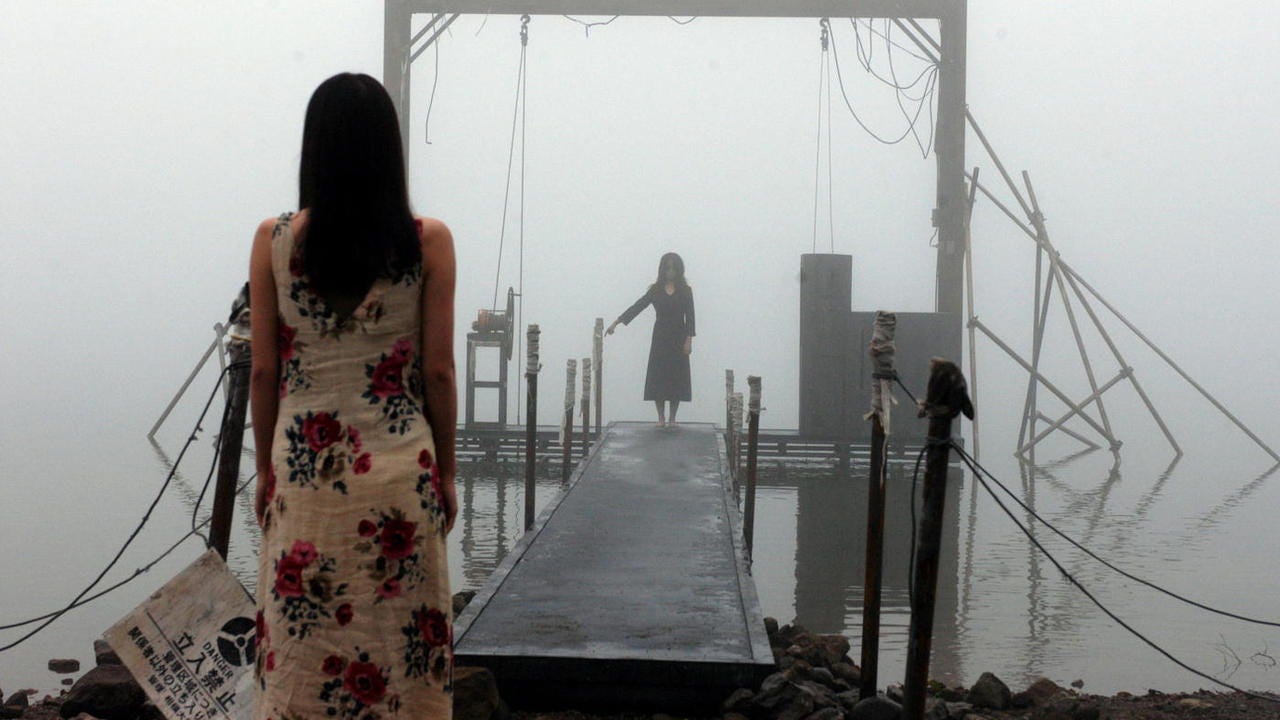
Kurosawa’s 2005 horror film Loft is an underrated entry Kurosawa’s filmography but its Gothic themes make it an essential text when trying to grasp his thematic fixations. Loft tells the story of Reiko Haruna (Miki Nakatani), a successful writer suffering from writer’s block and a mysterious ailment which causes her to cough up what appears to be a mud-like substance, who moves to a secluded countryside house to finish her new novel at the urging of her editor, Koichi Kijima (Hidetoshi Nishijima). One night, she witnesses her neighbor, an archeologist named Makoto Yoshioka (Etsushi Toyokawa), secretly transporting a cloth-wrapped object that turns out to be a mummy he recently discovered in a nearby swamp. Reiko investigates and learns about the house’s previous occupant, another writer who mysteriously disappeared. As she grows closer to Makoto, she is stalked by a black-clad ghost (Sawa Suzuki) who turns out to be connected to Makoto’s past.
That thing so often barely contained beneath the surface of Kurosawa’s films is amorphous, a mess of historical, cultural, political, and economic dimensions which is here put into a symbolic confine via the thousand-year-old mummy at the center of its narrative. The mummy was a woman who died after swallowing mud to preserve her beauty and Aya (Yumi Adachi) makes a derisive comment about the practice (“The things women do for vanity.”) not realizing that the system that gave rise to it is still in place today, choosing to remain ignorant of the ways in which her story overlaps with that of the mummy.
Reiko, by contrast, doesn’t get that choice and the past makes itself known by not only cursing her with this strange illness but also by closing the door on the plans her and Makoto, who confesses to Reiko that he accidentally killed the house’s previous tenant, make to leave the past dead and buried behind them. The past inexorably haunts the present; it’s the idea that, most obviously, sits at the heart of Kurosawa’s ghost stories but is often just as present in his ambient thrillers, his dramas, his comedies, and even his romances. And haunt it does, its tendrils whipping wildly from between the cracks so many of his characters desperately try to seal off (2001’s Pulse and its flimsy red tape that supposedly keeps spirits contained, the pointless sleuthing for “motive” in Cure).
A lot of what it said about Japanese art and literature post-WWII is tied back into the country’s rapid shift to liberal democracy and the cultural trauma of the bombings of Hiroshima and Nagasaki. Loft’s focus on misogyny, a hatred that predates modernity, circumvents this: history’s unforgiving force lashes out at the protagonists not just from beyond the grave but from the depths of thousands of years of history, powerful enough to obliterate any notion of forgetting, moving on, of simply letting the past be the past.
Even though Kurosawa’s work boasts a sturdy material grounding, it has, on occasion, taken a more metaphysical turn as well. If Cure was an attempt at grappling with Japan’s Lost Decade, his 1999 film Charisma, which forms a loose trilogy with Cure and 2006’s Retribution, functions as a kind of post-script, a definitive leap into the postmodern wasteland that sheds the skin Cure was still enveloped in. The film, like much of Kurosawa’s oeuvre, is rife with political, tonal, interpersonal, and textural tensions, but things are particularly pronounced this time around as the filmmaker juggles existential anguish and philosophical and ecological themes with a bizarre dry humor that fuses his lighter yakuza films — the Suit Yourself or Shoot Yourself!! series (1995-96), Eyes of the Spider (1998) — with his first two, French New Wave-indebted features, 1983’s Kandagawa Pervert Wars and 1985’s Bumpkin Soup.
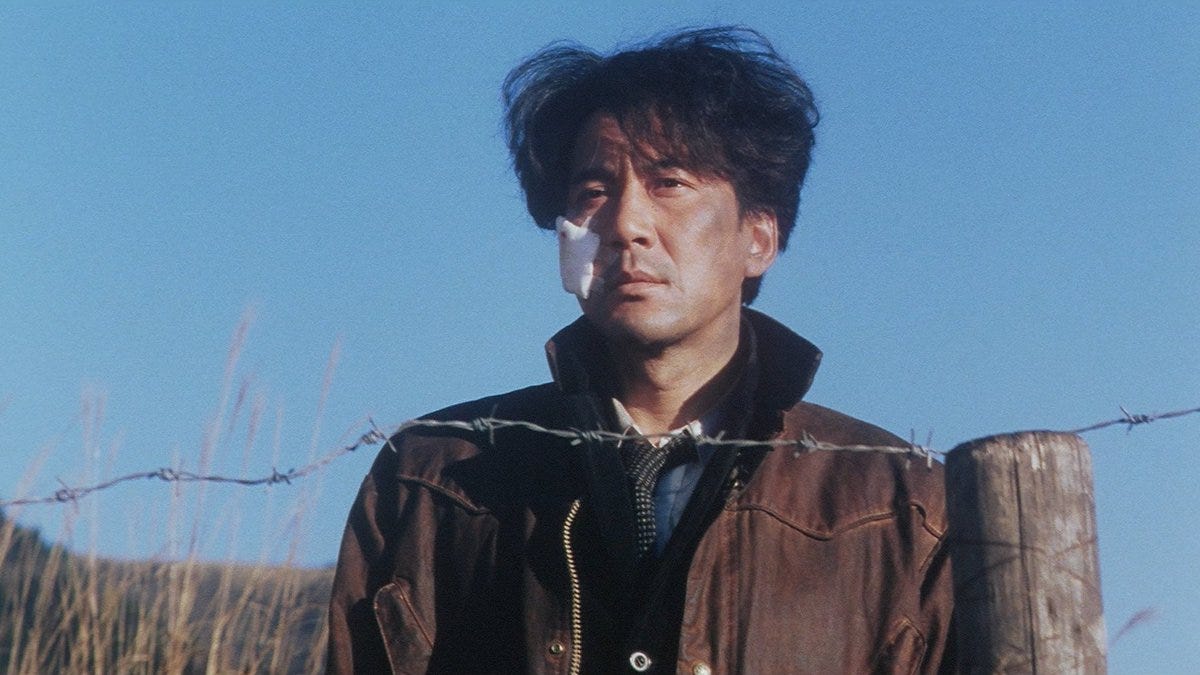
The film centers on a mysterious tree named “Charisma” and the emerging dispute between different factions that each have their own ideas about what to do with it. The hostage negotiator Goro Yabuike (Yakusho, whom Kurosawa favored for these burned-out lawman roles), who has been put on leave after failing to stop the murder of an MP (Masaaki Nagata), find himself caught in the middle of the dispute after he, for reasons unknown, is dropped off in the woods where Charisma grows.
It’s fascinating to see what Kurosawa spins this premise into. Like he did with Cure, he identifies a void at the heart of Japanese society, one ripped all the way open by the onset of modernity, one that seems to go beyond the confines of politics and history into the realm of what could be referred to as the human condition. (Charisma evokes Gnostic notions of a corrupt material world as well.) Yabuike comes to a rather fatalistic conclusion that, at a quick glance, seems to support this reading: he muses on the nature of life and death, describing them as part of the same force and saying that, ultimately, with or without Charisma some trees in the forest will live and some will die.
However, the film’s shifting political reality undercuts Yabuike’s “enlightened” (another idea central to Gnosticism) ambivalence the same way it does every position taken by the characters. The final shot of a city in flames and helicopters flying through the night sky is particularly eerie in that regard, not just for how it conjures a technological, bureaucratic vastness in the midst of a breakdown — an outside perspective on Pulse’s crumbling Tokyo — but for how it posits this breakdown as an inevitable outcome of our post-ideological ruin, one that is marked by the same ontological instability that harkens back to Hisao’s mystery yarn.
Though this instability, somewhat predictably, finds its most overt expression in his genre and genre-adjacent films, Kurosawa applies this logic to his more dramatic work as well. 2015’s Journey to the Shore, a romantic melodrama touched by the supernatural, is centered on Mizuki (Eri Fukatsu) whose boyfriend Yusuke (Tadanobu Asano) suddenly appears in their apartment after having died at sea three years previously. (He even adds the morbid detail that his body was eaten by crabs.) She reacts with surprising calm, wondering out loud what took him so long. The two embark on a journey where Yusuke plans to introduce her to the people who have aided him in his quest to make his way back to her.
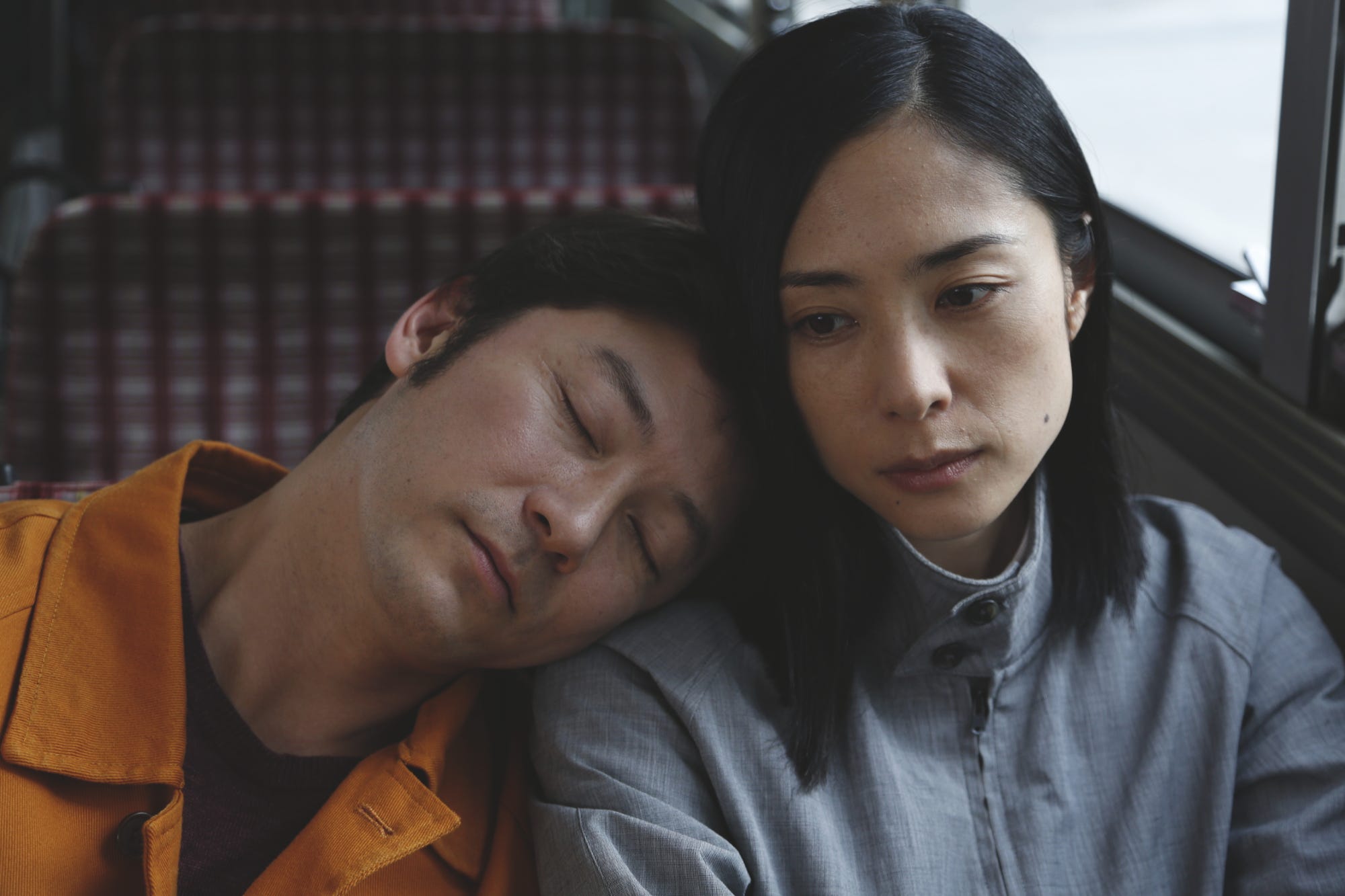
Mizuki learns that many of the people her boyfriend encountered were themselves dead but nonetheless inhabit the world of the living, moving among them unrecognized. Though the presence of ghosts is a Kurosawa trademark, there is next to nothing in the way of horror gestures to be found here. Still, the film is not a departure from Kurosawa’s usual preoccupations as much as it’s a reconfiguration of them. There is at least a tinge of sadness to a lot of his films, even (or especially) the ones that are mostly examined through a genre lens — “Forever... death was eternal loneliness,” says one of the ghosts in Pulse, adding, “I am not an illusion” — and Journey to the Shore could be examined along those lines as well if considered in the lineage of Jacques Tourneur or Tobe Hooper, the latter’s Eaten Alive (1976) and Spontaneous Combustion (1989) in particular.
The influence of Tourneur and Hooper are apparent in his most frequently discussed efforts, as are the noirs of Alfred Hitchcock (another director with a knack from melodrama, twisted as it may be), Robert Aldrich, and Richard Fleischer, but Journey clearly showcases the impact Yasujirō Ozu and, to a lesser extent, Mikio Naruse had on Kurosawa’s artistic development. The way in which he navigates this curious space where the boundaries between life and death subtly dissolve, the gentleness and patience with which he approaches his characters’ circumstances, often recalls those two filmmakers’ finest moments.
In terms of both form and subject matter, Kurosawa is more versatile than he’s usually given credit for but it is nonetheless compelling to see his style applied to such overtly emotional and dramatic subject matter. His editing, which is often abrupt and underlines his dry sense of humor as well as emphasizes some of his more brutal instincts, is put to heart-rending use in Journey as characters and their relationships will blink out of existence in the span of a single cut. In Naruse’s Floating Clouds (1967), the tragic death that enables the romance between Yumiko (Yōko Tsukasa) and Shiro (Yūzō Kayama) is also what casts a shadow over the beauty and excitement of their new love (the film’s alternate title is Two in the Shadow); in Journey it is the very instability that makes the supernatural reunion possible that continually looms over the two lovers.
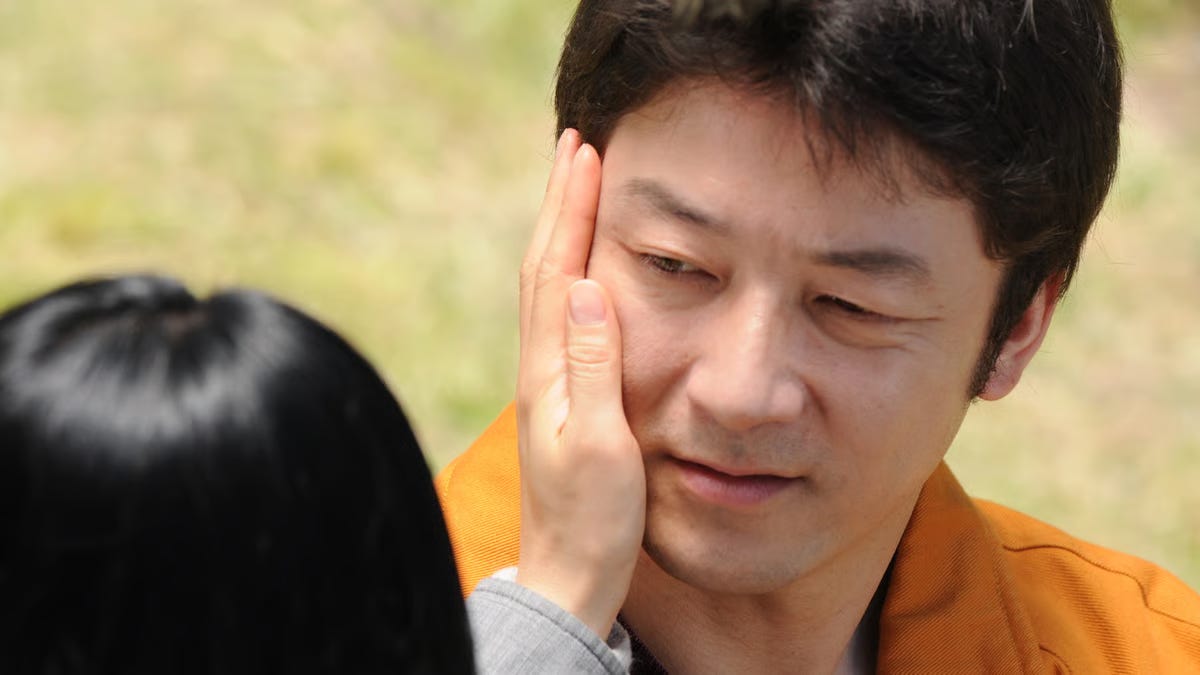
The thematic richness of Kurosawa’s work often emerges from his interaction with genre conventions rather than being constrained by them. One of the more admirable things about Kurosawa is that he doesn’t think himself “above” any of the material he works with: he has done pinku sex comedies (Kandagawa Pervert Wars, Bumpkin Soup), haunted house films (1989’s Sweet Home), slashers (1992’s The Guard from the Underground), science fiction (1999’s Barren Illusion, 2013’s Real, 2017’s Before We Vanish and Foreboding), among others, all approached with a similar enthusiasm and a belief that genre filmmaking can produce things of great artistic value.
It’s this belief that allows Cloud (2024), Kurosawa’s most recent film until the Cannes Film Festival premiere of The Samurai and the Prisoner in May of this year, to navigate his sensibilities back toward more materialist concerns. Released the same year as his short horror film Chime and Serpent’s Path, a French remake of Kurosawa’s own gloomy 1998 V-Cinema psychological thriller of the same name, Cloud is a relatively pure genre exercise, in the vein of The Revenge: A Scar That Never Disappears (1997) and Creepy (2016). But even with this purist approach, Kurosawa nonetheless excavates a litany of contemporary anxieties and tensions.
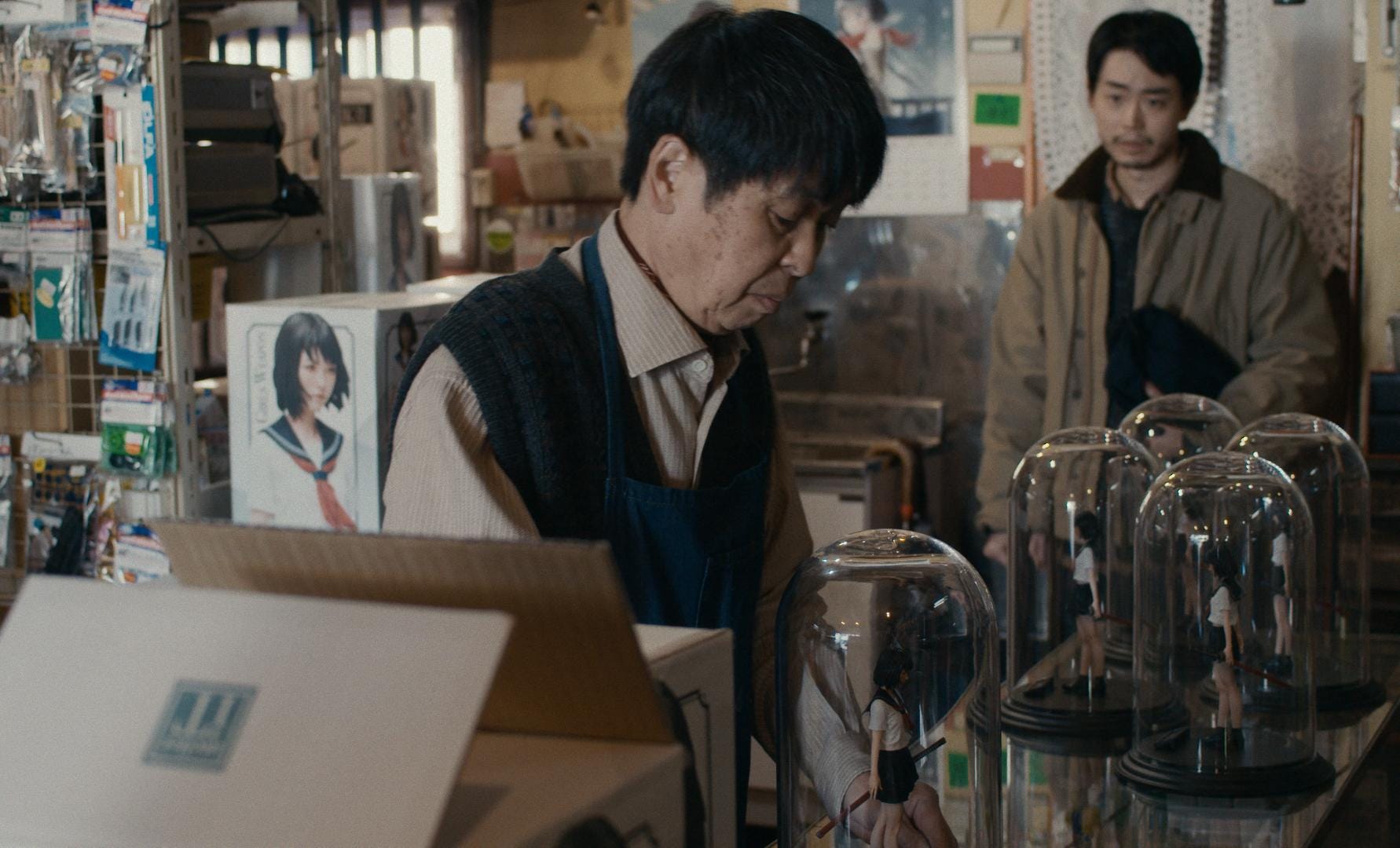
Ryosuke (Masaki Suda) is a factory worker who leaves his job behind to work full-time as an online reseller, infamous for his ruthlessness. His callous business practices cause numerous clients and customers to come together in an online forum to vent their frustration. As more and more people join in, someone eventually manages to find out Ryosuke’s address and a small group decides to band together to exact revenge against him, including a yakuza (Yutaka Matsushige) and Takimoto (Yoshiyoshi Arakawa), the owner of the factory that previously employed Ryosuke.
Though the film begins as a satirical dark comedy about the gig economy and online hustle culture, it transforms into a life-or-death action thriller when the armed vigilantes make their way to his home with plans to kidnap, torture, and burn him alive while streaming the whole thing online. The aforementioned ontological instability is often what drives Kurosawa’s propensity for third-act escalations of scale — the epic gun battle showdown that concludes Suit Yourself or Shoot Yourself!! The Hero (1996), the ruined cityscapes and plane crashes in Pulse, the startling and uncanny manifestation of the plesiosaur in Real — and Cloud sees him pointing toward capital and its various economic and cultural mechanisms as a major destabilizing force. Critics tend to hone in on technology as a broad and depoliticized category but Cloud’s thematic focus only truly gains resonance for how efficiently it ties that focus back to the specific political and economic context technology springs from.
Kurosawa’s ideas and philosophical disposition often come through on the strength of his mise-en-scène rather than solely through its setting or dialogue, another thing he shares in common with Hooper, a filmmaker he has often expressed admiration for. Like Chime, which concludes with a jarring audiovisual rupture, Cloud doesn’t develop as much as it continually and unpredictably unravels: Ryosuke’s misdeeds (his past) slowly catch up with him and the usernames on his screen manifest as real people; the digital world invades the physical one, violently shifting the film’s reality from a relative, if uneasy, stability to an intoxicating eruption of genre violence which, once more, succeeds at unveiling the film’s expansive subtextual scope.
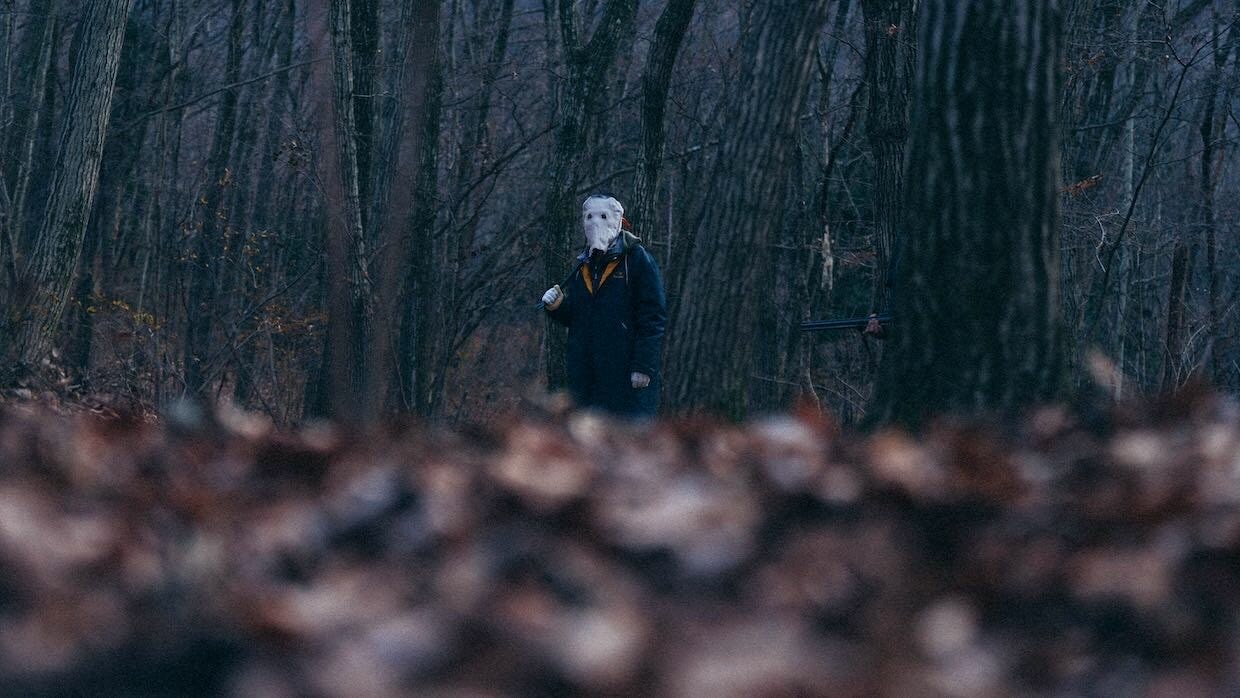
Cloud ends on a characteristically apocalyptic note: Ryosuke sits in a car with Sano (Daiken Okudaira), a mysterious character Ryosuke had previously hired as an assistant before firing him, the sky above them a sickly yellow-green, filled with billowing storm clouds. Sano urges Ryosuke to keep focusing on making money but Ryosuke, having lost everything including his girlfriend, Akiko (Kotone Furukawa), is disillusioned. “Where will that get me?” he asks. “Everything will be obtainable,” Sano responds. “Even things that can end the world.” Ryosuke is despondent but also trapped in a prison of his own making, unable to move beyond the parameters of his hollow existence. “I’m doomed,” he murmurs and a final thought enters his mind as darkness envelops him: “So this is how you get into hell.” There is a mystical charge to the film’s coda but Kurosawa’s meaning comes through with rare clarity: the hell Ryosuke enters was created (and can only be dismantled) by human beings.
Thank you once again Fred, reread this after revisiting Cloud + seeing Samurai and Prisoner.
Enjoyed this a lot